

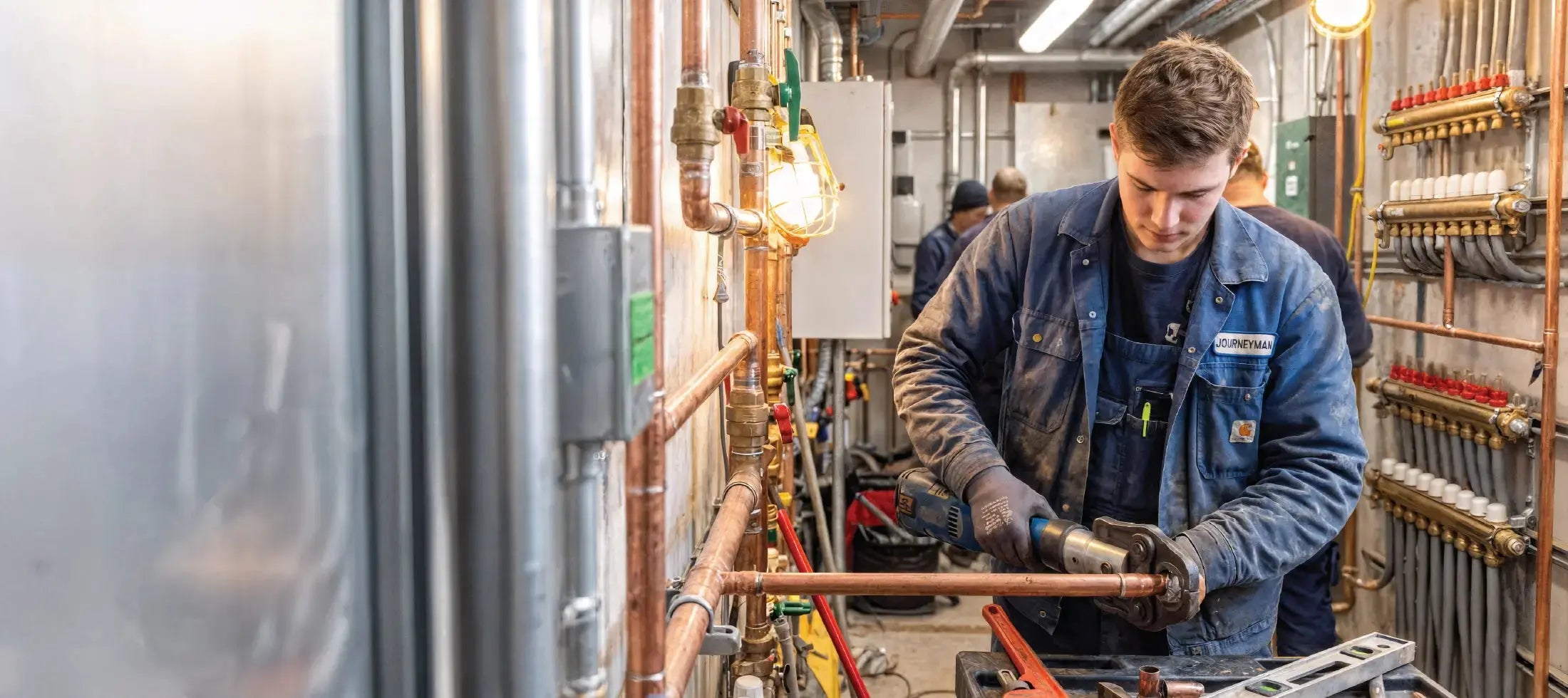
- The skilled trades are not "plan B" — they are an important career path with good pay, security and job satisfaction
- Professional skill is an identity, not just a job — it brings meaning and belonging
- Denmark needs craftsmen more than ever before — demand is high
- Being qualified is about independence, responsibility and seeing the results of your work
Craftsmanship matters. It is a sentence that should be said out loud, and often.
Not because craftsmen need validation from society — they know how important they are. But because we as a society forget it, and because it affects the choices young people make.
Today, fewer young people are choosing vocational trade educations. They choose university degrees instead — degrees that often turn out to be less hands-on, less tangible and less well paid than the trades they pass over.
It is not just about money. It is about identity, meaning and the future.
Craftsmanship and society — we need each other
Craftsmen build the society we live in — literally. Carpenters build houses. Electricians keep the power on. Plumbers keep the water running. Bricklayers build walls. Blacksmiths shape metal. Only when all these people have done their work can the teacher teach at school and the doctor operate at the hospital.
Without the skilled trades, society would collapse within days. There would be no new construction, repairs would go undone, and the infrastructure would fall apart.
And yet the trades are often regarded as "plan B" — what you choose if you cannot get into university. That is both wrong and harmful.
Denmark has too few craftsmen. There is a shortage of skilled carpenters, electricians, plumbers, bricklayers and other trades. Employers cannot get work done on time, simply because there are not enough craftsmen to do it. That means prices rise, and it means society-wide projects are delayed.
If we want security, infrastructure and welfare, we need craftsmen. There is no way around it.
Denmark is short of craftsmen today — particularly in construction, plumbing, electrical work and trade services. Employers cannot get work done on time, and skilled professionals can command higher pay because they are in high demand. That is both a snapshot of the times and a source of leverage for those who choose the trades.
Professional skill is an identity, not just a job
Being a carpenter, electrician, plumber or blacksmith is more than a job. It is an identity. It is a way of seeing the world, an appreciation of quality, and a sense of belonging to a trade community with shared values.
Many craftsmen say the most important thing about their trade is not the pay — it is being able to see their work, knowing it matters, and working with people who understand and value quality.
Professional skill also brings self-respect. It is hard to be unhappy in a job where every day you can see and touch what you have created. It is hard to talk yourself down when you know the work you deliver is of high quality and matters to people.
In a world where many feel empty and purposeless in their work, this is an enormous value. Craftsmen have an inner compass — they know what matters. And that matters for their mental health and job satisfaction.
A survey among European craftsmen showed that around 80% report high job satisfaction. That is far above the average among office workers.
Craftsmanship is tangible — you see the result
As a craftsman, you see the result of your work. Not as abstract numbers in a spreadsheet or words in an email. You see it physically.
The carpenter sees the house that has been built. The electrician sees the light that comes on. The plumber sees the water that flows. The blacksmith sees the metal that has been shaped.
This tangibility is enormously important for happiness and motivation at work. It is one of the reasons craftsmen often report higher job satisfaction than many other professions.
It is also about being able to measure success in a way many office jobs cannot. You know how good you are — and so do your customers. There is no doubt, no ambiguity. The work speaks for itself.
That is hugely important for self-worth and self-image. When you can see and touch what you have made every day, and when it works and lasts, it builds character and confidence.
- You can see and touch what you have created — no doubt about its value
- Feedback comes directly from the customer and from the result itself
- The working day ends with something concrete — not just meetings and emails
- Quality is objective — it is not up for debate or interpretation
- The career path is clear — you get better by doing the work again and again
- Pride comes naturally — you can point to your work
The trades open doors to independence and leadership
One of the most important aspects of being a qualified craftsman is that you can go independent. You can start your own business, set your own prices, and work with customers you choose yourself.
For many craftsmen the path looks like this: first employed by another craftsman, then their own business, then perhaps employees, then perhaps more branches or specialisations.
It is a natural career path many can picture for themselves — and it opens doors to higher income and self-determination that university graduates often never experience.
Many craftsmen earn considerably more as independents than they would have as employees, and without the same stress. That is because demand is high, and quality craftsmen can be selective.
There are also good leadership and teaching roles for craftsmen. Becoming a head of training, a project manager or an instructor at a vocational school is possible too — and there is a need for professionals who understand the craft from the inside.
The future for craftsmen is secure
While some industries are automated away, craftsmen will always be needed. A house cannot be built by robots. A damaged cable has to be repaired by people. Craftsmanship is human attention and expertise.
In fact, demand for craftsmen has only grown over the past 10 years. There is a shortage of craftsmen, and they are paid well.
That also means wage development for craftsmen is typically positive. As it becomes harder to find skilled craftsmen, pay levels rise to attract talent to the trades.
Some forecasts show the shortage of craftsmen will grow considerably over the next 20 years, as many experienced craftsmen retire without enough younger ones to replace them. That means the craftsmen qualifying now are entering a market where they are in enormous demand.
Many young people who qualified in a trade have gone independent and now earn considerably more than they would have with a university degree. And they work with less stress, because their value is recognised and their work is tangible. Their career is secure.
Choosing a trade as a career
Choosing a trade is choosing a career that matters. It is choosing independence, tangibility, and a professional community that values quality.
It is also choosing a future where you are not competing with millions of others for the same job. Demand for craftsmen is high, and that brings both security and influence.
Becoming qualified is not just about getting a certificate. It is about becoming part of a tradition, a professional community, and a set of values that make the work meaningful.
And it is about pride. Pride in the trade — as we mentioned earlier — is not something to be modest about. It is something to be celebrated and recognised.
When we celebrate a newly qualified craftsman — with words, with gifts, and with recognition — we are saying that we value their choice. We are saying that professional quality matters. We are saying that craftsmanship is important.
Are you about to qualify, or is a friend? Mark the milestone properly.
journeyman gifts" style="background:#0079C1;color:#F1FAEE;padding:10px 24px;border-radius:4px;text-decoration:none;font-weight:bold;display:inline-block">See journeyman gifts →Craftsmanship matters. Full stop.
There is no reason to talk around it. Craftsmanship matters to society, matters to the individual, and matters to the future.
When we celebrate craftsmen — with journeyman gifts and proper celebrations — we are not just celebrating people. We are celebrating values: skill, quality, independence, and work that means something.
And we send a signal to the young people facing career choices: it is honourable to be a craftsman. It makes financial sense. And it is meaningful.
Denmark needs craftsmen. More than ever. Let us celebrate them when they qualify — for the choices they have made, and for the future they are building.
Founder · Udlært · Design and product development since 2013
CVR 38935836
Henrik is a qualified tradesman himself and sees every day how much professional skill matters. He believes craftsmanship should be valued in society — in both word and deed, not least through gifts that mark and celebrate the newly qualified.
Share:
Pride in the trade and craftsmanship — why SkillsDenmark and the journeyman's exam matter
The journeyman's certificate — what it means to qualify as a craftsman